
THE TIMES https://bit.ly/3Wo4xzV
Oxford start-up strikes deal to license its weedkiller technology
Moa Technology is aiming to tackle the growth in herbicide-resistant weeds that can reduce crop yields by more than half
Wednesday July 10 2024, 12.01am, The Times

An Oxford start-up developing ways to kill herbicide-resistant weeds has struck a breakthrough deal with the Australian group Nufarm to license its technology.
Moa Technology, led by chief executive Virginia Corless, has sold the rights to a synthetic herbicide developed in its facilities in North Yorkshire, where it uses miniature plants to find synthetic and biological herbicides.
The deal is thought to be worth hundreds of millions of dollars in staged payments and royalties from future sales, based on projections of sales of similar herbicides in industry disclosures by the likes of Bayer’s crop sciences division.
Corless, 41, who joined Moa in 2021 from a German clean technology business, said: “This agreement is further validation of our unique capability to find new herbicidal modes of action at an unprecedented rate and optimise them to become viable candidates for commercialisation.”
“Our talented team is working hard to provide new options to help farmers to grow food sustainably, and that means finding forward-looking partners like Nufarm who share our vision and want to work with us on the next stages of development and commercialisation.”
Moa is aiming to tackle the growth in herbicide-resistant weeds, such as pigweed, mare’s tail and water hemp, which can reduce crop yields by more than half. Its technology is based on research by co-founders Liam Dolan, professor of botany at the University of Oxford, and former research fellow Clément Champion. They spun the company out of Oxford’s plant sciences department in 2017. It raised its latest round of investment in 2022, securing £35 million from investors including Lansdowne Partners, IP Group and Oxford Science Enterprises.
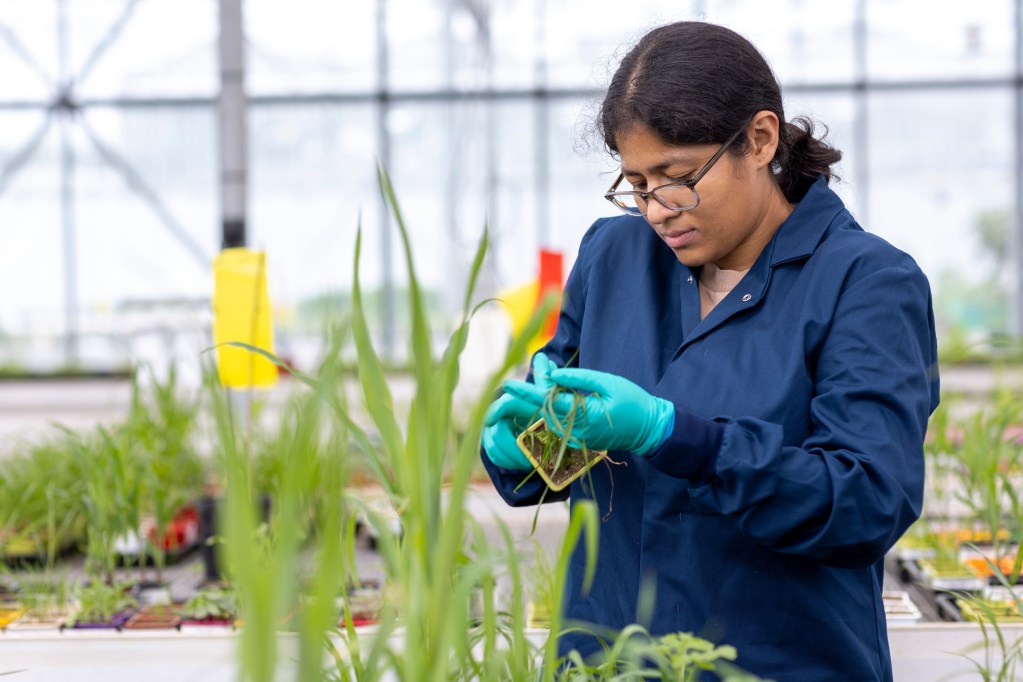
Weed biologist Ujjaini Sengupta assessing the effect of a herbicide on the weed lolium multiflorum.
In March, Moa struck a ten-year partnership with speciality chemicals group Croda International to develop bioherbicides for farms, which will be produced in volume at Croda’s manufacturing facilities. The FTSE 100 company estimated that the $5 billion biopesticide market is growing at about 8 per cent a year.
Moa operates research glasshouses on a 75 hectare site at Cawood between Leeds and York in North Yorkshire, where its novel biological and synthetic herbicides are tested on 14 different weed species.
Bayer, the German pharmaceuticals group, said last month that it would launch ten blockbuster products from its crop sciences division in the next ten years to support farmers, including a new herbicide molecule that had the potential to make €750 million a year in revenues.